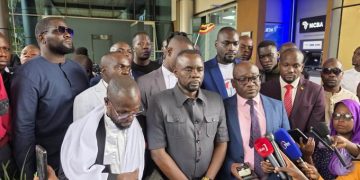







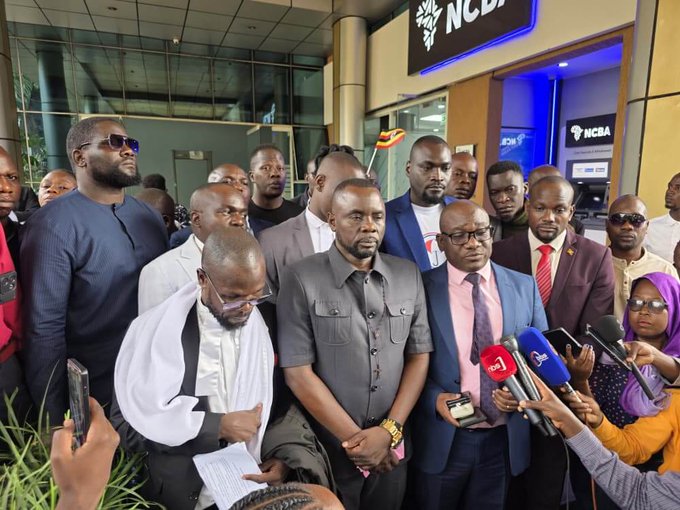
For the past two weeks, news headlines have been awash with the predicament of parliamentary aspirant Mathias Walukaga, stemming from questions around his academic documents and their sufficiency.
The main debate revolves around whether or not he has the equivalent of a Senior Six or A-Level certificate. A very important side debate, however, is whether this requirement is truly necessary to serve or represent one’s constituency effectively in Parliament.
This time round, we have many sports leaders vying for parliamentary seats in next year’s January election.
The Walukagga issue is therefore not far from our attention as sports leaders. One of the primary roles of Parliament is to make the laws that govern our country. As such, many argue that a Member of Parliament needs to be well educated to properly interpret the literature required to make good laws.
I myself did Physics, Chemistry and Biology at A-Level. I want to say honestly that there was almost nothing in any of those PCB classes that could help me if I decided to join Parliament. You do not need to have studied the same subjects to appreciate that there is nearly nothing in chemistry, for instance, that directly helps an MP.
When you think about it carefully, it appears that students of Arts subjects would make better MPs after studying subjects such as History, Political Education, Economics, Divinity and Literature.
One can be forgiven for arguing that Geography may help a little in Parliament, but you could easily be called mad if you insisted that Physics has anything to do with the work of MPs.
I have been President of Table Tennis in Uganda for the last 12 years. I recently handed over on 30th June this year after spearheading the introduction and later the observance of term limits in the Table Tennis constitution in 2017. I served two terms of four years each, from 2017 to 2021 and from 2021 to 2025.
We shall never know whether a student of Arts subjects would have removed term limits to hang on to the presidency a little longer, but I can confess that I learnt nothing in my PCB classes about leading a national sports organisation.
During my tenure, I helped improve the Table Tennis budget from zero to about UGX 320 million per year. I left behind both a World and Africa champion, the first ever dignified office for the sport, the best national league in the history of Table Tennis which was also broadcast live worldwide, a return to continental and world medals, and the local manufacture of Table Tennis equipment, among other achievements. Many would have expected a PCB student to end up as a doctor, but I shelved my medical dreams to become a teacher of chemistry. I later shelved my teaching career as well to lead Table Tennis to all these achievements and more.
It may also be fair to expect leaders of national organisations to at least have degrees in Business or Human Resource Management, both of which I lacked, yet I still achieved the above.
When I compare all this to the Walukagga dilemma, I wonder whether a PCB student would make a better MP or national organisation leader than a student of History, Economics and Divinity. A good leader must know their history, have a solid understanding of the country’s economy, and subjects like Divinity, which instill strong moral values, are clearly an added advantage in shaping good leaders.
If PCB studied at A-Level has little or nothing to do with making laws in Parliament, why should a PCB student qualify to run for MP while someone without an A-Level certificate does not? Additionally, if a PCB student can make a good sports leader, why should anyone place so much weight on A-Level documents to disqualify a candidate from running for Parliament?
Whatever the outcome of the court ruling on Walukagga’s disqualification, this is an area we must all examine carefully if we truly want the best MPs for our country.
My suggestion is that we establish a special course for anyone who wishes to become an MP. This course could be as short as one year or even six months. During this period, all intending MPs should learn key areas such as the history of our country, the existing laws that govern the nation, the state of the economy, the law-making process, the actual work done in Parliament, and core values like honesty, forgiveness and transparency.
These values could be drawn from Divinity or Religious Education. Such a course would be a far better yardstick for qualifying MP candidates than a mere A-Level certificate.
The writer is a bush lawyer, former President of the Uganda Table Tennis Association, Secretary General of the Union of Uganda Sports Federations and Associations, and a Board Member of the Uganda Olympic Committee.