






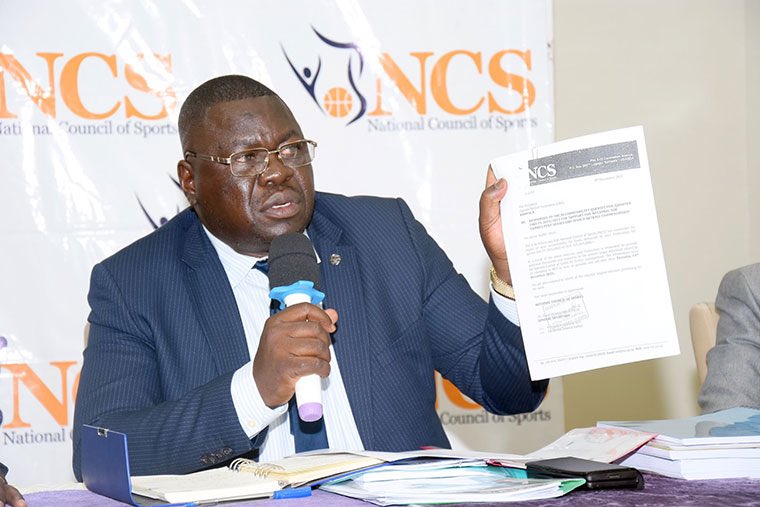
Last week on Friday, January 23, 2026, the National Council of Sports (NCS) held a press conference at Lugogo where it announced an additional five months for National Sports Federations and Associations (NFs) to conform to the requirements of the Sports Act 2023.
NCS had initially set a conformity deadline of June 14, 2025, which was later relaxed. Granting more time to the NFs to find ways of complying with the new Sports Act shows that NCS fully understands the challenges involved in this process. For this, NCS deserves to be greatly applauded.
The new Sports Act has one major challenge, which involves NFs ensuring their presence in at least half of all the districts of Uganda, that is 73 districts. Such a rollout requires equipment, coaches, training sessions, district competitions, and more.
All these components require substantial financing. No NF leader is going to use personal funds to successfully carry out such a rollout because these federations are not personal property.
The rollout itself has never been the responsibility of NFs under any known previous statutes. Interested Ugandans have traditionally set up sports clubs on their own initiative, and this cannot be done forcefully by NFs.
Penalizing federations for lack of presence in half the districts of Uganda therefore becomes extremely unfair, even more so because no other country in the world licenses NFs using such a parameter. Mandatory presence in half the districts of Uganda is also unrealistic because some sports disciplines are extremely expensive to roll out, such as motorsport and swimming. Rally cars, motorcycles, and swimming pools are very costly to acquire.
Other sporting disciplines such as golf, cricket, and baseball require large amounts of land. A standard golf course, for instance, requires more than 100 acres of land.
How many districts in Uganda can offer this kind of land purely for playing golf? How many districts can gazette enough land for rally car racing, let alone maintain the expensive vehicles involved? Can districts facing water shortages reasonably be expected to embrace swimming pools?
Furthermore, even for more affordable sports like badminton, can the establishment of just one court in an entire district be considered sufficient coverage? If badminton were to set up a minimum of 20 courts per district, can the federation realistically afford this with a government allocation of only 260 million shillings per year?
And if government funding cannot support such a massive rollout, does anyone truly expect badminton leaders to sacrifice their personal money to achieve nationwide coverage? Similar questions arise for NFs that receive as little as 10 million shillings per year from government.
The Sports Act 2023 should have provided for the funding required to implement the district coverage condition. Such funding should have been clearly addressed in the Certificate of Financial Implications.
There is also the issue of District Sports Officers (DSOs), whose role under the Ministry of Public Service is expressly and statutorily designated as sports development in the various districts of Uganda. This same designation is not expressly assigned to NFs in any known statute.
The Sports Act 2023 further stipulates under Section 46 that all educational institutions in Uganda must provide a minimum of 15 sports activities for their learners. With over 50,000 schools and more than 50 universities in Uganda, if this provision had been enforced since 2023, almost all districts would by now be hosting nearly all sports disciplines. Assigning this responsibility to individual schools would achieve district-wide coverage far more easily than placing it on underfunded NFs.
In summary, the pressure placed on NFs to establish presence in half the districts of Uganda without providing enabling funding is misplaced and outright unfair. This has never been the responsibility of NFs. It is the role of government, working through its DSOs.
While NCS has granted NFs more time, the best way forward is for NCS to work closely with the federations during this period to return to Parliament and either soften the district coverage requirement or secure the funding necessary to implement the law as it currently stands.
The objective of the Sports Act 2023 was to enable more Ugandans to play and enjoy sports. This was a noble and welcome goal. However, it cannot be achieved without adequate funding, as no individual can be expected to deploy personal resources to carry out such a massive task on behalf of government.
The Government of Uganda must also reflect on why failure in this area by its own DSOs is now being used to punish innocent NFs.
The writer is a bush lawyer, former President of the Uganda Table Tennis Association (UTTA), Secretary General of the Union of Uganda Sports Federations and Associations (UUSFA), and a Board Member of the Uganda Olympic Committee (UOC).