






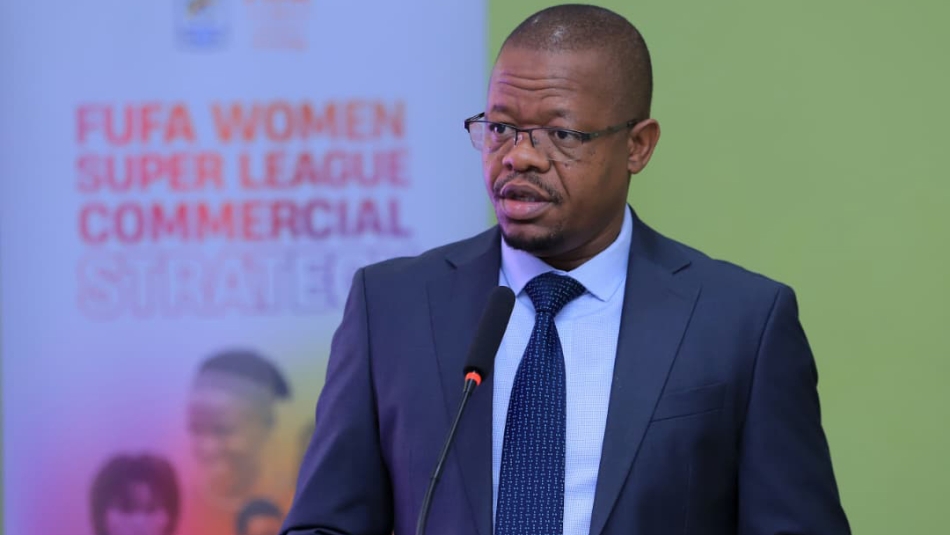
FUFA President Moses Magogo has reaffirmed the federation’s commitment to professionalising women’s football in Uganda, pointing to commercial growth, infrastructure development and targeted investment in the girl child during the launch of the FUFA Women Super League Commercial Strategy in Kampala.
Speaking at the event held at Imperial Royale Hotel, Magogo reflected on the early days of the women’s game in Uganda, noting how limited opportunities once forced girls to play alongside boys before organised teams and competitions gradually emerged.
“Women’s football has had a very long journey here in this country. At a time when there were few girls who wanted to play football, the only option they had was to play with the boys. Eventually, teams were formed, competitions followed and stars were born. That is how we arrived where we are today,” he said.
Magogo welcomed FIFA’s decision to select Uganda, alongside Romania, as pilot countries for a women’s football commercialisation project, describing it as a sign of global confidence in the federation’s progress.
“This shows the confidence FIFA has in what we have done here. We want to thank FIFA and convey our appreciation to President Gianni Infantino on behalf of the football people of Uganda,” he noted.
He said FUFA’s strategic direction, supported by government backing and increased FIFA funding, has strengthened programmes and improved commercial capacity. “Sometimes progress is slow, but that is the right way. Football needs money at all levels, and over time we have been able to build our commercial skills, receive government support and benefit from increased FIFA funding,” Magogo said.
Magogo stressed that legal protections and infrastructure remain essential for football commercialisation, saying investment depends on secure rights and adequate facilities. “You cannot commercialise when your rights are not protected by law, and you cannot package football without infrastructure. Through engagement with stakeholders and government, we now have pieces of infrastructure that make commercialisation possible,” he added.
He pointed to a growing cultural shift in Uganda where families increasingly accept girls playing football and pursuing education and careers through the sport. “Today, parents and relatives have accepted that a girl child can play football, get education and even earn a living. That, for me, is a big success,” he said.
The FUFA president also highlighted governance reforms that have increased female representation across federation structures and referenced the Women in Football programme as part of deliberate support measures.
He called on institutions, stakeholders and individuals to sustain investment in women’s football. “This is my appeal to all of you, to support the girl child in every way possible, because you are giving another Ugandan the opportunity to benefit from their God-given talent,” he concluded.