






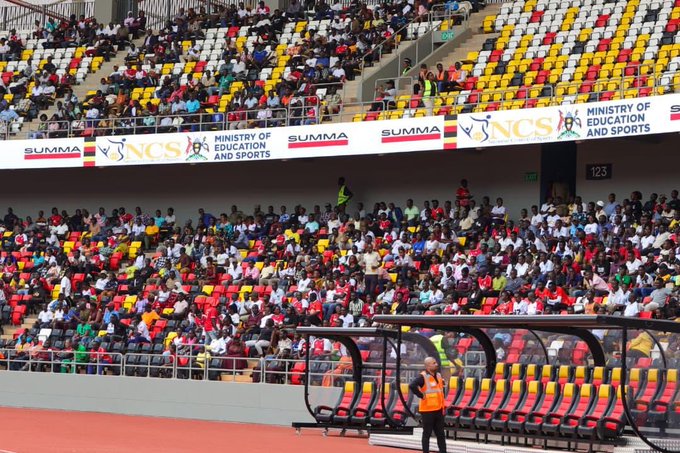
The huge government investment in sports infrastructure such as Hoima City Stadium and Arena was long overdue, necessary, and deserves applause.
Government has injected about UGX 1.3 trillion into the establishment and upgrade of sports infrastructure this year.
However, the allocation to National Sports Federations (NFs), which manage all athletes and coaches in the country, stands at just about UGX 48 billion. This is roughly 4 percent of the UGX 1.3 trillion allocated to infrastructure, which is a very disturbing statistic.
This wide gap raises an important question about which should come first in sports development: human capital, meaning athletes, coaches, referees, and related personnel, or infrastructure.
In some sectors, such as banking, infrastructure traditionally comes first, although even this idea is increasingly challenged today due to mobile and agency banking.
I am strongly convinced that in sports, human capital development should always lead infrastructural growth, while establishing infrastructure first does not necessarily result in human capital development.
By human capital investment, I mean directly improving athletes’ welfare by providing more equipment, competitions, salaries, prize money, and opportunities to attend international championships, among others.
Football offers a clear example. With a government allocation of over UGX 10 billion over the past five years, the football governing body, FUFA, has not built more than two stadia in Uganda.
Currently, it owns Kadiba Stadium in Mengo, Kampala City, and Njeru Stadium in Buikwe District near Jinja City.
Despite this, football has the highest number of clubs, players, and playing fields in the country, spread across almost all districts. None of these are owned by FUFA or the Government of Uganda. Nearly all are privately owned.
FUFA does not spend its billions constructing stadia. Instead, it invests primarily in football administration and in creating attractive competitions with good prize money and allowances. FUFA runs several strong and competitive championships, including the StarTimes Premier League, FUFA Big League, Women’s League, FUFA TV Schools Cup, Regional Leagues, and the FUFA Drum.
By offering good prize money and additional benefits such as allowances and travel opportunities, FUFA has created competitions that attract many Ugandans to establish their own clubs and competition infrastructure.
FUFA has never created a football club in Uganda, despite its significant budget, and rightly so, as this is not its role. The creation of clubs and playing arenas is the responsibility of interested Ugandans who are drawn to a particular sport.
The FUFA example clearly shows that when attractive competitions exist, people will independently establish clubs, acquire players and equipment, and secure playing venues in order to benefit from the prize money and other incentives.
The sport of pool provides another strong example. The introduction of pool tables with coin slot systems enabled Ugandans to earn money by charging UGX 500 per game, corresponding to the value of the coin required to release the balls. Many people rushed to buy pool tables and set up venues, either by renting or constructing them.
This growth was further accelerated by the Pool Association of Uganda (PAU) through the introduction of a National Championship whose winner received attractive prizes such as a brand new car. Participants began at qualification stages held in clubs across different districts. PAU did not buy tables for districts, nor did it build or rent playing arenas. Interested individuals did this themselves.
Across the country, many Ugandans have established five-a-side football pitches for futsal. Others have set up swimming pools as commercial ventures. Some have started netball clubs to benefit from attractive allowances and travel opportunities to countries such as England, Wales, Scotland, and Canada. In table tennis, my own sport, some clubs have emerged specifically to take advantage of the many educational bursaries available to talented players.
By adding value to athletes and providing attractive benefits for them and their coaches, Ugandans will naturally establish the clubs and infrastructure needed to access those benefits.
This mirrors the situation where government builds good roads and private investors then follow with hotels, banks, and other developments. In sports, there is often less need to worry excessively about infrastructure. Greater emphasis should be placed on improving player and coach welfare, while allowing interested citizens to develop the infrastructure.
I therefore urge government to significantly increase funding to National Sports Federations in the coming year.
Allocating only UGX 48 billion to player and coach development while committing UGX 1.3 trillion to stadium construction is a worrying trend, especially when a single stadium in Hoima is expected to consume as much as UGX 500 billion. Such imbalances raise a fundamental question: who will play in these stadia if there are not enough athletes and coaches being developed? This is how white elephants are created.
We must prioritize athletes and coaches over playing arenas. If Hoima had 500 football clubs, private investors would naturally consider building stadia using their own capital because the market and fan base would be evident. Heavy investment in infrastructure while underfunding athlete and coach development is like creating excess supply where demand is grossly inadequate.
The writer is a bush lawyer, former President of the Uganda Table Tennis Association, Secretary General of the Union of Uganda Sports Federations and Associations, and an Executive Board Member of the Uganda Olympic Committee.