





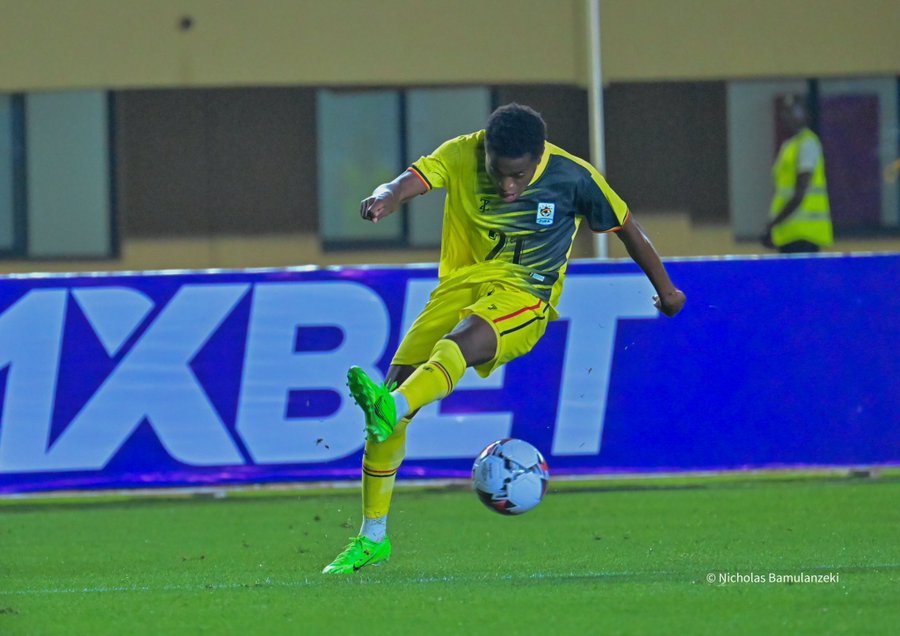
If football were a meritocracy, Allan Okello would have walked into Uganda’s starting XI against Tunisia without so much as a tactical debate.
Instead, the most productive Ugandan footballer of the last 12 months was reduced to a late cameo; six minutes, to be precise, as the Cranes slid to a 3-1 defeat at the 2025 AFCON. Six minutes. Apparently, that was all the time Uganda could afford to give its chief creator. And yet, in those six minutes, Okello still managed to expose the absurdity of the decision.
Before Tunisia, the numbers were already screaming. Five goals and four assists in his previous ten outings for the Cranes. Three goals and four assists in six World Cup qualification matches in 2025 alone. Overall this year? Six goals and five assists in 14 international appearances.
At CHAN, against continental peers, he added three goals and an assist in just five games. Domestically, he finished the 2024/25 Uganda Premier League as the top scorer with 19 goals and four assists, from midfield, no less, before starting the 2025/26 campaign with Vipers SC in similarly ruthless fashion: two goals and three assists in six games.
This is not form. This is sustained excellence.
Yet Paul Put, faced with Tunisia and the need for incision, imagination and composure between the lines, opted instead for Melvyn Lorenzen, a talented forward, yes, but one who had played just twice for Uganda prior to this tournament. The rationale, it seemed, leaned towards “power” over football. Muscle over mastery. Presence over production.
The irony? Lorenzen was withdrawn at halftime.
Even more biting was what followed. When Okello was finally unleashed, with the match already slipping beyond reach, Uganda suddenly remembered how to play. The ball stuck. The tempo shifted. Tunisia looked uncomfortable. And from Okello’s involvement came Denis Omedi’s consolation goal, a reminder that Uganda’s best footballer does not need warm-up minutes, bedding-in periods or philosophical justification. He simply needs to be on the pitch.
The decision to marginalise Okello was not just conservative; it was self-sabotaging. For the past year, Uganda’s spine has been obvious to anyone watching closely: Okello as the creative heartbeat, Rogers Mato providing thrust and unpredictability out wide, and Aziz Kayondo offering balance and intelligence from left-back.
This trio has driven Uganda’s most coherent attacking spells, blending technique, movement and tactical awareness. To sideline one-third of that equation at AFCON, and arguably the most influential third, is to voluntarily dull your sharpest blade.
As Uganda now turns its attention to rivals Tanzania, the question is no longer about Okello’s credentials. Those have been settled, repeatedly, emphatically, and across competitions. The real question is about conviction from the bench. Does Paul Put trust evidence, or instinct? Data, or dogma? Football, or physique?
AFCON is not a laboratory for experiments, nor a stage for stubbornness masquerading as strategy. It is a tournament that rewards bravery, the courage to pick your best players and live with the consequences. Uganda cannot afford another evening where its most decisive footballer watches from the sidelines while answers are sought elsewhere.
Six minutes were enough for Okello to make his point against Tunisia. Against Tanzania, Uganda may not be gifted even that margin for error.