





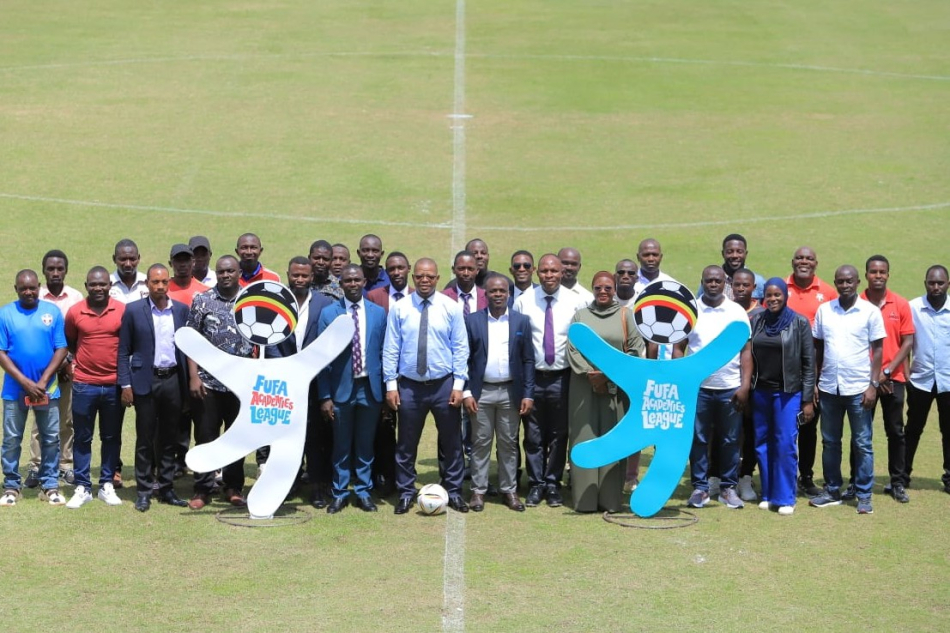
Federation of Uganda Football Associations president Moses Magogo has officially launched the FUFA Academies League, describing the new competition as a key step in strengthening the development pathway for young footballers in Uganda.
Speaking at the launch on Monday, Magogo said the initiative is supported by the FIFA Talent Development Scheme and forms part of FUFA’s broader Technical Master Plan, which guides the development of players from early talent identification to elite performance.
“The Federation of Uganda Football Associations took a very ambitious project called the Technical Master Plan. It has many pillars and activities but in summary it focuses on the life cycle of a player, starting with talent identification where we are working with FIFA under the Talent Development Scheme,” Magogo said.
He stressed that identifying talent is only the beginning of the process, noting that the federation must deliberately guide young players through structured development.
“After identification of talent, which is a very important phase, you go into elite path development. For you to get a top professional we must be intentional in the things we do,” he added.
According to Magogo, the most critical stage for identifying football talent occurs between the ages of nine and eleven. Players identified during that phase are then expected to progress through recognised football schools and licensed academies.
He also noted that FUFA has introduced regulations to govern the operation of academies in line with the National Sports Act.
“It is no longer free. It is now illegal to operate an academy or a group of children without a licence from the National Council of Sports and you cannot obtain that licence without the approval of FUFA,” he said.
As part of improving standards, the federation has introduced a grading system for academies. Grade One represents the National Football Academy, which FUFA plans to relaunch under the Technical Master Plan. Grade Two academies are mainly attached to professional clubs and qualified private institutions, while Grade Three academies largely operate at the regional level, including schools of excellence.
Magogo explained that organised competitions will play a key role in measuring development and providing exposure for young players.
“We took a decision as a federation to use competitions as a method of showcasing the development going on in academies. That is why we are here today to launch the academies competition, which we are calling the FUFA Academies League,” he said.
The pilot edition of the competition will feature 20 academies from the Buganda and Kampala regions. The teams will be divided into two groups and compete until a champion is determined.
Magogo said the new league complements the existing FUFA Juniors League by providing opportunities for academies and players who are not currently part of that structure.
“We are aware that there are many academies that are not part of the Juniors League and there are many children growing up from there. This competition will give them an opportunity to compete and showcase their development,” he explained.
FUFA has also appointed a seven member Tournament Organising Committee to supervise and manage the competition.
“FUFA organises many competitions. For purposes of concentration, responsibility and supervision, the federation named a seven member committee to organise this competition. We believe they will take responsibility to deliver a good competition that can eventually spread across the country,” Magogo said.
He added that the league will also serve as a platform for identifying players for national development structures.
“The objective is to give children in development an opportunity to compete and showcase their progress. It will also serve as a hunting ground for the National Football Academy and the national teams to identify players for the underage national teams,” he said.
The competition is scheduled to kick off on March 22, with FUFA confirming that each participating academy will receive ten footballs to support their participation.