






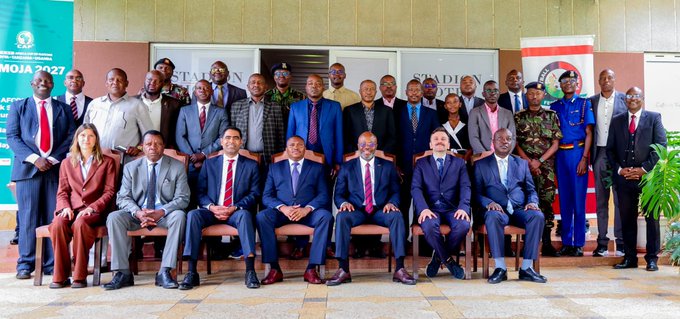
Security planning has become a major focus in preparations for the 2027 Africa Cup of Nations, with Kenyan officials insisting the tournament can only succeed if safety and coordination measures meet CAF standards.
Speaking during the opening of a two-day CAF and Local Organising Committee security workshop at Kasarani Stadium on Wednesday, Kenya’s Principal Secretary for Sports, Elijah Mwangi said security would be central to the successful delivery of the tournament that Kenya will co-host with Uganda and Tanzania.
“This workshop is very important in delivering a CAF-compliant football event. For an event of PAMOJA AFCON 2027 magnitude, security is a central pillar towards the successful delivery of this great event,” Mwangi said.
He said the tournament would attract thousands of players, officials, supporters, dignitaries, media and international guests from across Africa and beyond, making safety arrangements a critical part of planning.
“Ensuring their safety and guaranteeing a peaceful, secure and seamless tournament experience is therefore of utmost importance,” he added.
Mwangi said organisers were preparing for “complex security dynamics” linked to an event of AFCON’s scale and stressed the need for proactive planning, intelligence-led operations and stronger coordination between agencies.
“Kenya is fully committed to delivering a secure environment that reflects our capability, professionalism and hospitality as a nation,” he said.
According to Mwangi, the workshop discussions are aimed at strengthening operational coordination between agencies, improving intelligence and emergency response systems, identifying high-risk areas and developing measures to prevent criminal activity, hooliganism and threats to public order during the competition.
He added that organisers also wanted wider collaboration involving transport operators, emergency response teams, venue managers, communities and sports stakeholders to create what he described as a “comprehensive and participatory security framework” for the tournament.
“The training and resolutions emerging from this workshop will be cascaded across all relevant institutions and stakeholders to ensure a harmonised national approach towards safety and security during the tournament period,” Mwangi said.
Hussein Mohammed, the president of the Football Kenya Federation, said Kenya still needed to close gaps in its preparations to satisfy CAF requirements.
“We must address all gaps to ensure we stage a unique tournament that provides a unique fan experience for Kenya’s fans,” Hussein said.
“Ensuring a safe, secure, and well-coordinated environment for players, officials, and fans is central to delivering a successful 2027 AFCON.”
The workshop, organised by the United Nations Office on Counter Terrorism in Sports, also brought together representatives from the Kenya Police Service, Directorate of Criminal Investigations, Kenya Defence Forces, National Anti Terrorism Centre and National Disaster Operations Centre.
Officials said discussions would include crowd management, traffic control, cross-border movement, airport and port security, venue protection and safety arrangements for VIP guests.
Mwangi also said infrastructure works linked to the tournament were progressing, with construction of match venues and training facilities being accelerated ahead of the competition, which will run from June 19 to July 17, 2027.